
Recover Insurance Revenue During the Holiday Slowdown
For many medical practices, the holiday season brings fewer clinic days, lighter schedules, and slower patient volume. While this period is often viewed as a financial challenge, it can be one of the most strategic times of the year—especially for practices looking to recover insurance revenue for work that has already been completed.
Unpaid and underpaid claims accumulate throughout the year as practices focus on patient care and daily operations. The holiday slowdown offers a rare opportunity to step back, review billing performance, and collect revenue that may otherwise remain unpaid.
Why Insurance Revenue Often Goes Uncollected
During busier months, billing inefficiencies tend to go unnoticed. Claims are submitted, but follow-up may be inconsistent. Denials are addressed individually rather than strategically. Over time, these issues result in revenue being delayed—or never collected at all.
Common reasons insurance revenue is left uncollected include:
-
Aging claims that were never followed up
-
Denials that were not appealed
-
Missing or incomplete documentation
-
Workflow delays in billing and collections
These issues do not necessarily indicate lost revenue—they indicate unrecovered revenue.
Why the Holiday Season Is Ideal for Financial Review
With fewer appointments and reduced operational pressure, the holiday season allows practices to focus on billing and financial health without constant interruption.
Using this time to recover insurance revenue helps practices:
-
Improve cash flow before year-end
-
Prevent claims from aging out
-
Identify recurring billing issues
-
Enter the new year with cleaner accounts
Rather than generating new revenue to compensate for losses, practices can reclaim what they are already owed.
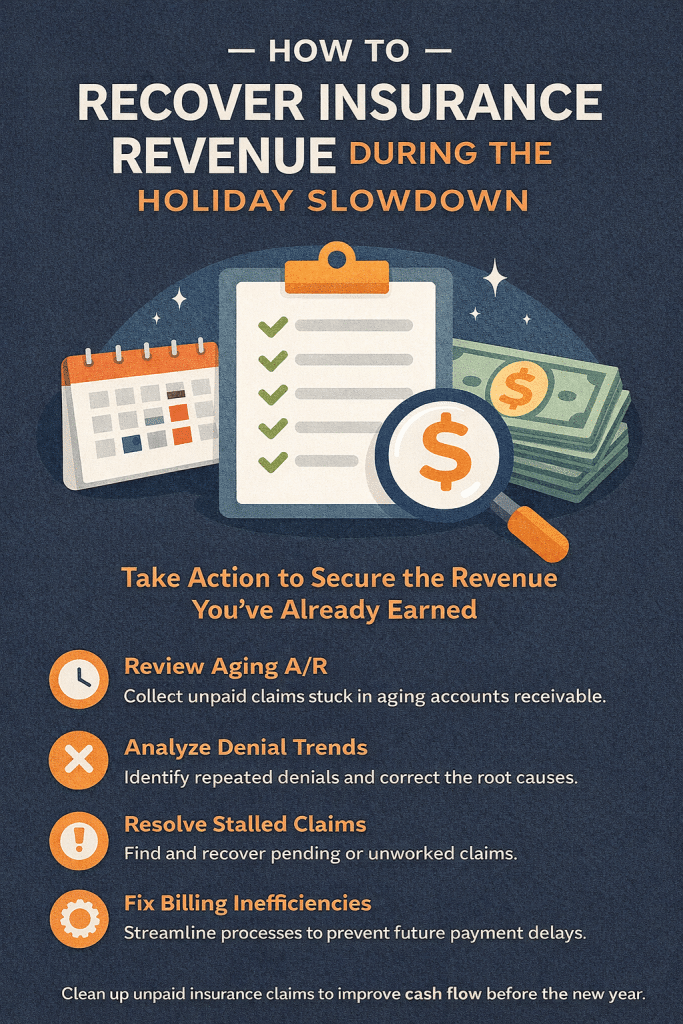
Review Aging Accounts Receivable to Recover Insurance Revenue
Aging accounts receivable (A/R) is one of the most important indicators of billing performance. Claims that sit unpaid for extended periods are more likely to be denied permanently or written off.
Key areas to review:
-
Claims over 30, 60, and 90 days
-
High-dollar unpaid claims
-
Payers with consistently slow response times
-
Claims missing documentation or responses
Addressing aging A/R during the holiday season can result in faster payments and more predictable cash flow.
Analyze Denial Trends to Prevent Future Revenue Loss
Denials are rarely random. Most follow consistent patterns that repeat throughout the year.
Holiday downtime allows practices to analyze denial trends such as:
-
Frequently denied CPT codes
-
Payers requiring additional documentation
-
Modifier or diagnosis mismatches
-
Frequency limitation issues
By identifying and correcting these patterns, practices can reduce future denials and improve reimbursement accuracy—making it easier to recover insurance revenue moving forward.
Resolve Unworked or Stalled Claims
Every practice has claims that fall into a stalled status. These may include claims marked as pending, denied once without appeal, or delayed due to missing information.
During slower periods, staff can:
-
Reopen unresolved claims
-
Contact payers for clarification
-
Submit missing documentation
-
Appeal incorrect or incomplete denials
Many stalled claims are still payable if addressed in time. The holiday season is often the last opportunity to recover them before they become unrecoverable.
Identify Workflow Inefficiencies in Billing and Collections
Recovering insurance revenue is not just about fixing old claims—it’s about preventing future losses.
Holiday financial reviews should examine:
-
Charge entry timelines
-
Claim submission delays
-
Denial tracking processes
-
Follow-up consistency
-
Patient balance workflows
Correcting inefficiencies now helps ensure that claims submitted in the new year are cleaner, faster, and more likely to pay.
Turn Financial Review Into Actionable Improvements
A successful review leads to clear action steps, such as:
-
Prioritizing high-value unpaid claims
-
Establishing standardized follow-up timelines
-
Improving documentation workflows
-
Strengthening denial prevention strategies
These improvements allow practices to start the new year with better systems and stronger cash flow.
Why Recovering Insurance Revenue Matters Going Into the New Year
Practices that fail to address unpaid claims often carry financial stress into Q1. Those that use the holiday slowdown strategically begin the year with cleaner accounts and improved revenue predictability.
Benefits include:
-
Reduced aging accounts receivable
-
Lower denial rates
-
Improved cash flow stability
-
More accurate financial forecasting
Recovering existing insurance revenue is one of the most efficient ways to strengthen a practice financially—without increasing patient volume.
Final Thoughts
The holiday slowdown doesn’t have to mean reduced cash flow. By using this time to review billing performance, resolve unpaid claims, and identify inefficiencies, practices can recover insurance revenue that might otherwise remain unpaid.
The work has already been done.
The services have already been provided.
The holiday season is simply the best time to collect what is owed.
At Aspire Health Management, we help medical practices collect the revenue they’ve already earned. Our focus is on accurate billing, proactive follow-up, and reducing unpaid claims so cash flow remains steady—even during slower seasons. Contact us to schedule a billing consultation and strengthen your practice’s financial performance this holiday season.